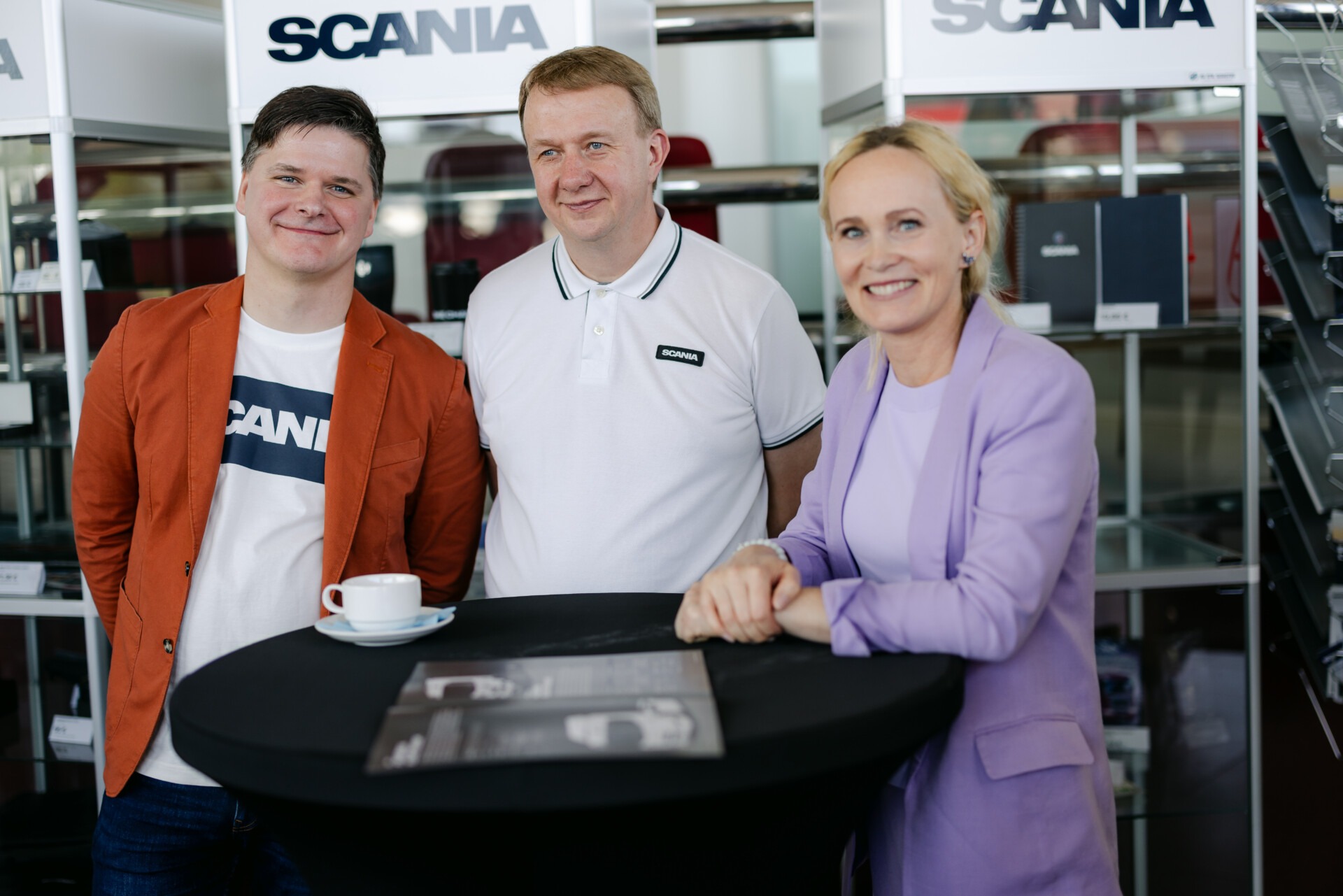
I interviewed Scania Eesti AS board member Alar Prääm and HR manager Maio Parv, with whom Nobel recently had a great piece of work.
While I do sometimes come across stagnation in companies with a long history and long-serving people, the Scania Eesti team is open to change and development – the essential foundation for building anything new in a training programme. I also admire Scania’s leaders, who decided to become better leaders as an entire leadership team, starting with the senior management. Everyone was on the training together, listening to one another and moving in step. Thirty Scania Eesti leaders took part in all.
I put a few questions to Maio and Alar.
What was the main problem you wanted the training to solve?
Alar: To raise the people-leadership capability and the quality of leadership among our senior service advisors, who are the technicians’ direct managers. That was our first thought, but we soon got to the point where every leader could take part. So that we would all be looking at the same picture.
Maio: The first push came from the results of our employee satisfaction survey, which showed that there was dissatisfaction among our people, including dissatisfaction with leadership.
Over the years Scania has trained its department heads a great deal, but not the levels below them. Yet the expectations of those leaders when it comes to leading people are just as real. So it seemed to me that this could not go on. If the expectations are there, you have to provide the training. My biggest wish was to give the senior service advisors the tools and to train their skills so that they could be good people leaders.
What were you most afraid of when you set to work with such a large group?
Maio: My greatest fear was that the things we learn on the training would never actually be put into practice. Getting people to practise what they have learned is always the biggest question mark.
Alar: Before we settled on the content, my fear was that historically our people have been less receptive to soft skills training than to technical training. It makes no difference whether it is sales techniques, customer service or leadership. If we had chosen a course full of high-level leadership theory and dry with it, we would certainly have failed. Our people would not have taken it on board. That was exactly my fear – that it would go too dry, and that very high-level theory simply does not work.
Raising the quality of development conversations was another goal. How to talk with introverted people. On the training we helped people talk. It is actually simple: whether it is family or employees, you have to talk – and that is a big step forward. Just talk! We learned how to build that readiness, courage and skill. Today the courage has grown. The 1:1 conversation used to be a kind of „taboo“. We took it on, and now it isn’t. This training raised our courage. We once had the same thing with stress – it was there in the organisation, but nobody talked about it. We took it on, we talked, and we got past it. There probably are and always will be leaders who still find it uncomfortable. Even so, I have heard many times since that the term 1:1 has entered everyday use at Scania after the training.
Which topics turned out to be the hardest to put into practice?
Alar: In the coming week we have information meetings where we will talk more about holding conversations, because the mid-point development conversations are due in September.
The hardest part is still this: what do I actually talk about with an employee in a 1:1, and how do I start? We are turning the group’s development conversation model into a short model and introducing 4-5 points to cover in the mid-point conversations with technicians. You don’t have to work through every question and point every time and tick the boxes. So we have points that help you hold a natural conversation. We are handing them the “fish” to make the whole thing feel more natural still. We need to get past the idea that talking with employees is an obligation.
Maio: The hardest part is getting them to genuinely make the time to sit down and talk with every employee. To simply do it. With certain people I have every faith that they will do it well. And some leaders don’t realise that if they don’t hold the conversations, it isn’t them who suffers – it is their employees.
What is the most important thing you took away once the programme ended?
Maio: Everyone took something away. It came as a big surprise to me how strictly everyone followed our global standard. Point by point. Every standard is created as an aid, not as a box-ticking exercise.
The biggest win from the training was getting to know one another and taking the time to simply be together. The rest comes down to each person’s own sense of responsibility — how much of it they actually put to use. What we know today is that many of them did. I know the points on running a conversation have been used a great deal.
Whether the senior service advisors have become better leaders, I can’t answer yet. A satisfaction survey is coming — that will give us one input. I’ll certainly ask about it in my next conversations with employees. I’m pleased about Rakvere — we had to let a couple of people go, and I could see that the conversations had been handled well and that people had been properly talked to. Leaving should never come as a shock.
Alar: You have to talk to people — talk, talk and talk again. Not only in a group, but one to one. The company has to create that format and that opportunity. We can come to work, be friendly, crack jokes and so on, but it’s the 1:1 conversation, where more private topics come up, that matters. And it’s a human need, too: to have attention paid to you personally, not just as part of a bigger group.
All participants also had the chance for 1:1 coaching after the training programme. What was the benefit of that?
Alar: Two things:
- You get to talk to another person, in a small and private setting, about your own leadership problems — otherwise there is simply no opportunity for that.
- With a neutral person you can open up topics you wouldn’t open up anywhere else. And you learn what it takes to be on the other side, in the coach‘s role. You can pick up the techniques and use them later.
Maio: The greatest benefit is that coaching makes you work out how you can make yourself better and set new agreements with yourself about what to do next. The 1:1 helps you put what you learned in the training into practice and improve yourself — your leadership skills, for instance, or others. Because in coaching you analyse yourself, work out how you can be better and set yourself small goals, you move forward as you achieve them.
Where are you now, five months after the programme?
Alar: The practical actions are in our heads. At the level of metrics — the satisfaction survey is coming up right now. We’ll see what has changed. We’ll get a sense of whether the weak spots have improved.
We have another round of information meetings coming up, where we’ll also talk to the technicians about what 1:1 conversations involve and why they matter.
The standard of regular meetings was uneven. Thanks to the training, morning meetings have become consistent and now take place everywhere, as do weekly meetings. And 1:1s have started happening.
Maio: Our goal was for everyone to hold development conversations and genuinely talk openly with their people, including at least one interim conversation between the annual development conversations.
What will you do next?
Maio: The next step is preparing the autumn interim conversations, which Alar and I will help run. We’re in Tartu next week already. We’ll hold the conversations and hand over the next goal. After that we’ll see how they get on. We’ve been thinking that in January next year we’ll hold a one-day gathering with all the leaders, where we’ll make sense of how it has gone, what we have done and what goals we set ourselves for the year ahead.
Alar: Now we have to keep striking while the iron is hot — that’s what next year will go on.
We’ll also put the focus on customer service. The senior service advisors got to talk to each other a great deal; customer service didn’t. Now we’re thinking about how to give them that opportunity too.
The training gave people a chance to talk about personal things — that helps to break the ice.
The training gave me my thought of the year, one I later heard from three other places, which cemented it: people learn when they are slightly uncomfortable. The same idea came up at the Pärnu leadership conference and at the Scania group’s leadership training. A leadership article I read said the same thing — success comes through discomfort. It teaches you, and even when something goes wrong, there’s comfort in knowing you actually learned from it. That is my thought for this year. Those small, uncomfortable exercises in a safe environment gave us the chance to try things out and to talk. A person in a panic doesn’t learn, which is why that training format was ideal for practising.
Is there anything else important that we haven’t talked about?
Alar: I’m immensely happy that it went the way it did. Coming back to the fears, it could easily have gone differently. Theory and practice were both in good shape. A large part of it came from our own input, and that worked. I have never heard such good feedback about a non-technical training course before. This time was different.
Feedback from a training participant:
My personal view is that this training taught me to listen. It has brought me closer to my colleagues and we’ve solved all kinds of tasks together. I’ve learned to have open conversations and I’ll definitely keep practising it. Thanks to this training I feel more confident. (Tõnu Pikkma, senior service advisor at the Scania Rakvere dealership)
Interviewer: Kristiina Tukk PCC, leadership coach