
Home for organisations Refreshing your strategy
strategy renewal
A constantly changing market means business strategy is never truly complete. Success requires regularly reassessing your objectives and cultivating a flexible company culture.
Only consistency, alertness and continuous adaptation will keep you successful in the market.

Strategy renewal is designed for organisations that want to keep their vision of the future firmly in sight and move with the changes around them. Creating or renewing a strategy is a process of building and learning together with your key stakeholders.
About the training
what is it?
Creating a strategy is a journey. We work with the leadership team and with people across the organisation, together and one to one, in order to:
- Agree on a shared mission and vision
- Identify the values and behaviours needed to achieve that vision
- Set the measures that matter and build routines and systems that deliver results
Everything is done together, so that your business stays balanced in a changing environment and reaches its goals.

outcome
- By the end of the programme, the organisation’s mission, vision and values have been reviewed and renewed.
- All the key stakeholders have been involved in shaping the strategy.
- A strategy is in place, along with a plan for rolling it out across the organisation.
- The methodology used with the leadership group can later be applied to strategic plans in individual units.
In the first stage we explore where the organisation stands today. We interview both the leadership team and the key stakeholders, using Peter Hawkins’ five disciplines model. The working group is given homework covering exercises such as SWOT, competitor analysis and a review of the current strategy and goals.
The second stage focuses on exploring culture. This stage is optional, but in Nobel’s experience it is essential for understanding values-based leadership and behaviour in the organisation.
Peter Hawkins' five disciplines model
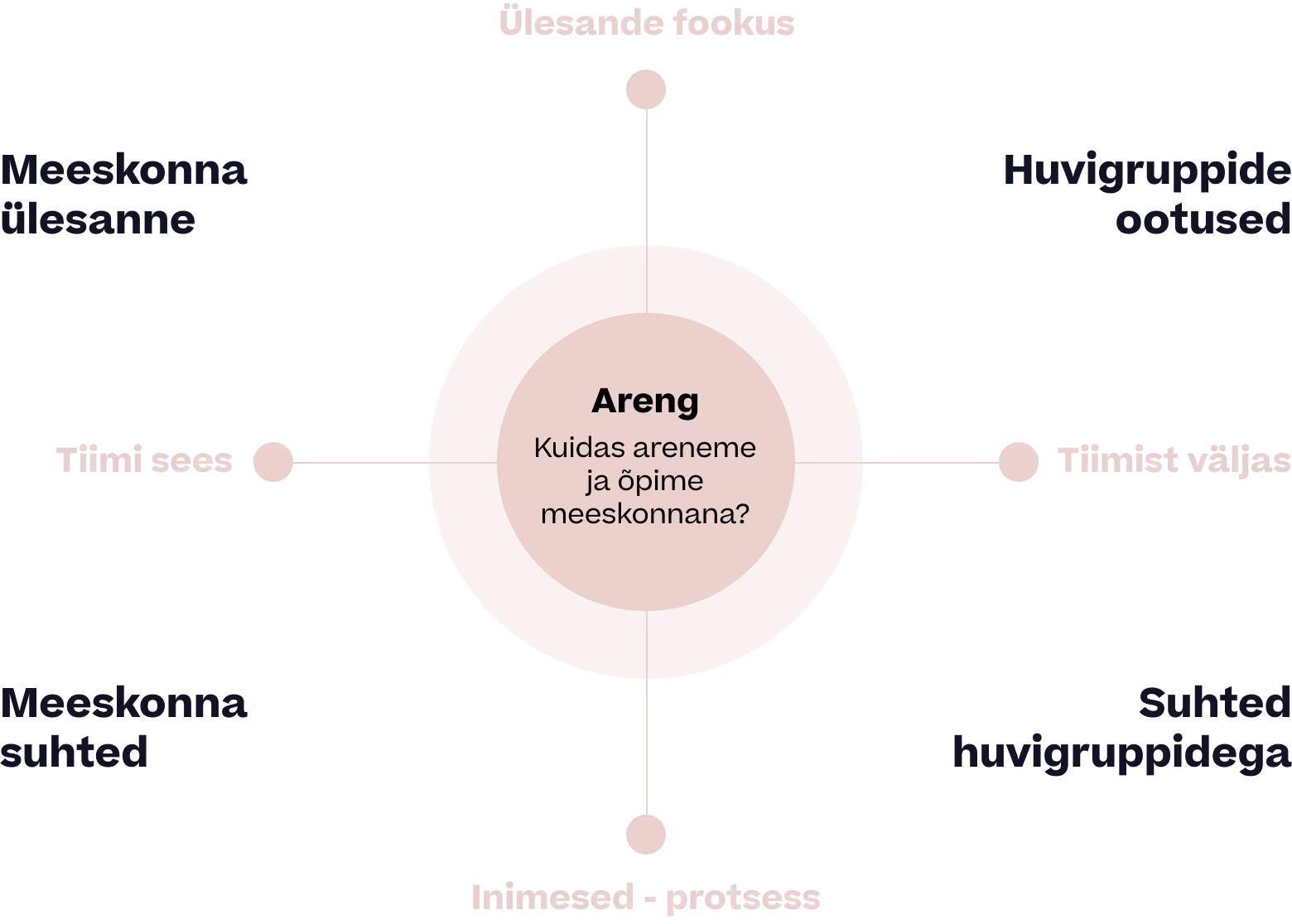
The team's task
What is the team’s goal?
What is the team’s background?
Vision, mission, values, goals – who owns them?
What is clear and what is unclear in your goals, roles and processes?
Relationships within the team
Who is on the team and who should be?
How would you describe the team’s culture and dynamics?
What goes unspoken?
How are differences handled?
What works and what does not?
Stakeholder expectations
What is the point of the team?
Whose interests does the team serve?
What do stakeholders expect from the team?
What external challenges does the team face?
What are the main challenges ahead?
Relationships with stakeholders
What are the relationships between the team and its stakeholders?
What do we already know about them?
How well can each team member represent the team?
Which stakeholder groups are we not engaging with enough?
The third stage is analysing the results and preparing the workshops, which use a range of practical and creative exercises to identify the future signals worth factoring into your own strategic planning.
How does it work?
Kick-off
Outcome: Everyone is clear on what will happen and how much time the programme takes from each person. The stakeholder groups to be involved are chosen.
Interviews and survey
Outcome: The coaches carry out the interviews and, where needed, a culture survey. The results are analysed and the workshops prepared.
Where we are today
Outcome: The results are interpreted - where we are today and where we are heading. Exercises in spotting the signals in society that could affect our business. Reviewing or creating the vision and mission - what we are here for. Interpreting the values.
Looking to the future
Outcome: Planning for the present and the future. Putting the vision and mission into words, building the action plan and its measures. Participants leave with homework.
Monthly workshops
Outcome: The focus is on agreeing on the strategic direction, the actions and the measures, with homework in between. Nobel's experience shows that ideas need time to settle, so a strategy cannot be finished off in a single workshop. The number of workshops depends on need and is agreed with the client.
Summary
Outcome: A summary. Where needed, the results are presented across the organisation.
trainers
Kristiina Tukk PCC
Professional executive coach
Barrett certified consultant
Kristiina brings over 20 years of leadership experience from both telecommunications and the financial sector. Under her leadership, the well-known information line Ekspress Hotline became Nobel Digital, which in 2019 was named Estonia’s most successful digital media agency. Today Kristiina is one of Nobel Digital’s leaders, a partner and a certified leadership coach.

Toomas Tamsar MCC
Master certified coach
Barrett certified consultant
Toomas’s track record as a senior leader is enviable (Tööandjate Keskliit, Pärnu Konverentsid, Tallinna Kaubamaja, Kaubandus-Tööstuskoda). He is one of Estonia’s most respected leadership coaches, and he shares what he has learned over a long and successful career with senior leaders in both the public and private sectors.
The training focuses on exploring leadership competencies, working through challenges and the leader’s role in developing people.
On the training we look at what a modern development, or collaboration, conversation could look like, where the company’s plans and the employee’s own wishes meet.
In the team workshop we analyse why a team is not working and agree on the changes needed.
The training brings key stakeholders together to shape the organisation’s mission, vision, values and strategy.
In the workshop we build the foundation for new values and give them substance through behaviours everyone understands in the same way.
In the culture survey we examine which behaviours and values dominate in the company today, and build an action plan for change.
The 360 values survey focuses on a leader’s behaviour and habits, and on their impact within the team.
Edith Mihkelson
„The essence, tools and practices of coaching leadership open up a whole new world for me as a leader and for the entire company. Inspiration, engagement and spotting new perspectives give us immeasurable potential to develop powerfully together with the team, using resources that are right in front of us but which we never thought to notice or use before coaching. We are on a journey that creates value both for the people of Kooker and for the whole community.“
Elina Siimon
“The coach’s help is valuable precisely because I reach the answers myself, by analysing the situation. Answers that align with my own convictions and values.”
Agris Peedu
Coaching gave me, as a top executive, the opportunity to address the issue in the presence of an experienced advisor – a coach – and with someone from outside the organisation.
James Woodeson
“The coach’s main role was understanding and belief in me — that I would manage — not stepping in and doing it for me.”
Mihkel Tammo
“Don’t expect the coach to know better than you do and tell you what needs to be done, but a genuinely experienced, high-calibre coach will help you put yourself to the test.”
Kadri Mägi-Lehtsi
“Coaching helps you move forward both at work and in your personal life.”